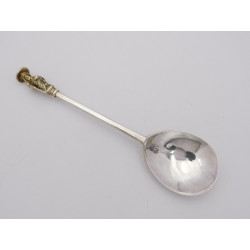
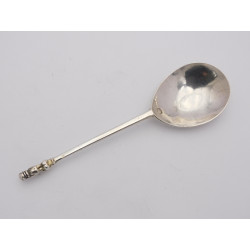
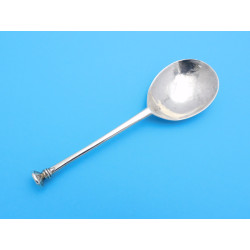
Medieval Silver Diamond Point Spoon c1400


Sold
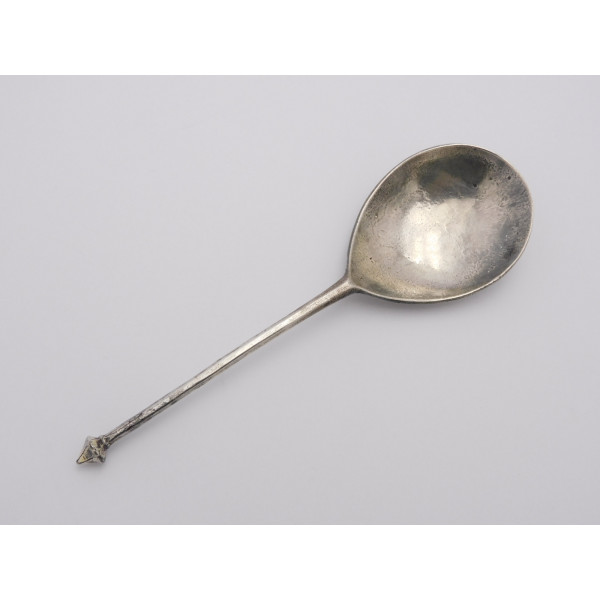
Spoon - Diamond Point - Unmarked, Circa 1400 - 15.6cm long; 27g - AT/7118
The earliest forms of spoon that can be called specifically “English” are the wrythen knop, the acorn knop and the diamond point. This is a very rare opportunity to buy a silver diamond point spoon that dates from circa 1400, mostly likely the reign of King Henry IV (1367-1415).
Diamond point spoons are often quite small and flimsy in nature with consequentential damage, however this example has a good sturdy feel to it and has survived in excellent condition with an unworn bowl. The spoon is unmarked but can be accurately dated from its form as medieval spoons followed a strict pattern of evolution.
As with all very early English spoons this example has a hexagonal profile stem that tapers towards its diamond point terminal and crucially for dating, the front and back facets remain narrow. The finely tooled, diamond-shaped terminal retains remnants of the original gilding. With its V-shaped shoulders, the deep fig-shaped bowl with steep drop from the shank and rudimentary rattail to the reverse are typical of the late 14th and early 15th centuries. Commmander How discusses and illustrates the bowl shape evolution in "English & Scottish Silver Spoons" volume one pages 8-10 and this spoon clearly fits the form of spoon no.1 (circa 1400).
Despite its great age, the spoon is in remarkably fine condition with an unworn bowl, no dings nor dents and no repairs. The surface shows evidence of sulphurisation and pitting which suggests that it may have been buried and thus preserved underground. The appearance gives it a very antique look and it certainly feels medieval!
A similar example is shown as spoon 12 in "The Benson Collection of Early Silver Spoons".
This spoon was made during a turbulent time in British history with the tussle for the English crown between the Houses of Lancaster and York that ultimately lead to the War of the Roses (1455-87).